Retrieval Augmented Generation (RAG) enhances the capabilities of a Large Language Model (LLM) by enabling it to draw directly from your organisation's own data. The result is clear, well-sourced responses produced automatically—removing the need for manual document review and freeing up valuable time for more meaningful work.
Zero Point AI has developed its own RAG-powered LLM, Sleuth, with a strong focus on security and sustainability. By optimising performance within a compact model, Sleuth delivers powerful results while remaining efficient. Customers can also choose to run the system on-premise, keeping sensitive information in-house rather than sending it to offshore data centres—helping organisations retain full control over their data.
Organisations may be required to show that they are able to "Learn from Experience" (LFE) as this is a key quality management step. An obvious starting point for this is to collect an LFE Register but applying the useful conclusions from this can be difficult. Which of them are applicable to a new task? What opportunities to improve safety or efficiency are there? Let's ask our Sleuth and see what we can learn efficiently and accurately.
How It Works
As with any Retrieval Augmented Generation approach, the process begins with a source dataset. In this example, this consisted of 79 safety related incident reports which provide a rich source of LFE Opportunities. Overall, this represents thousands of words of case studies. Reviewing this volume of material manually would be time-consuming, and the level of technical detail makes retaining critical information even more challenging. Instead, the full collection was ingested directly into Sleuth, where it was indexed and prepared for use.
Once this step is complete, interaction is straightforward. Sleuth behaves like a standard LLM: users pose questions in natural language, and the system returns clear, structured responses. The difference lies in the output—answers are grounded in the uploaded material, with references that point back to the exact documents and passages used, ensuring transparency and trust in the results.
Practical Demonstration
In this demonstration, we ask Sleuth - in simple natural language - for examples that are relevant to electric wiring work:
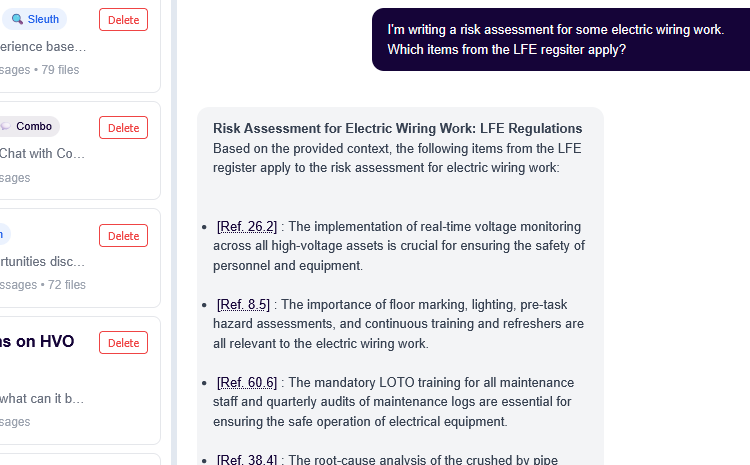
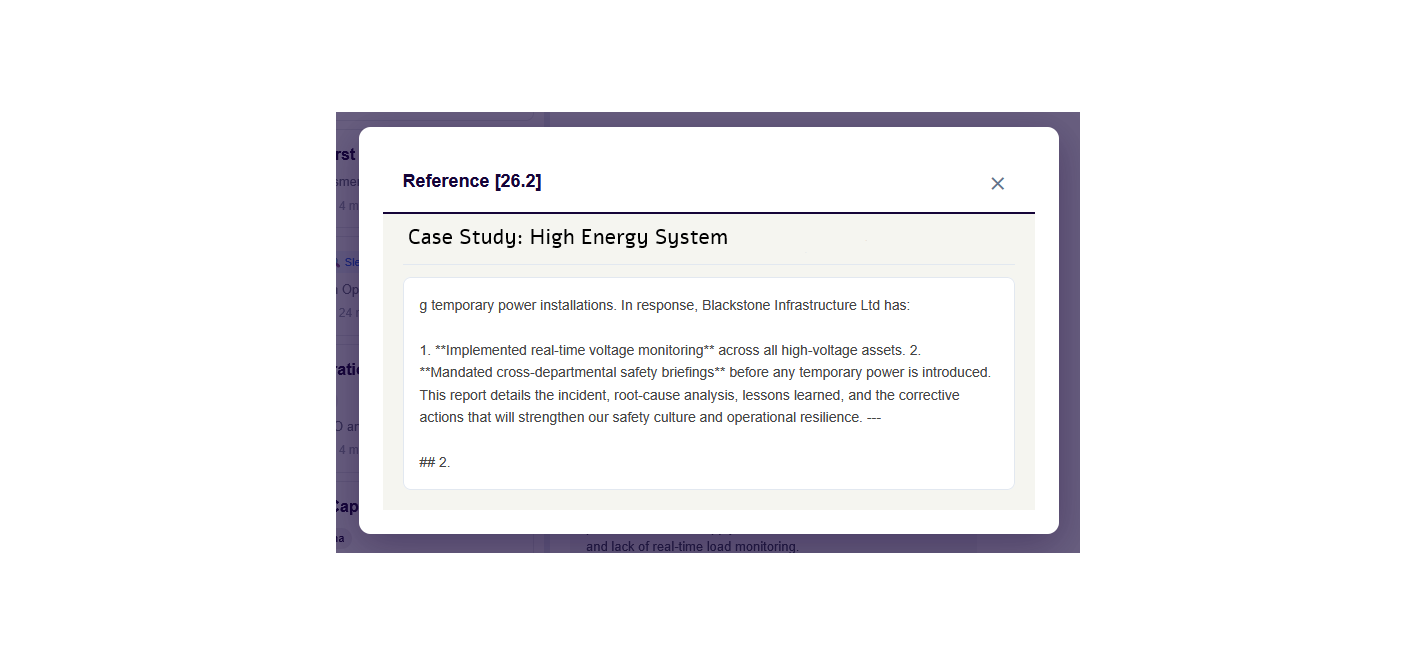
The answer goes on, referencing applicable cases as it goes and showing the user the sources to make the checking simple.
Do you have long and complicated datasets in your business? Would you save time by passing this task to an AI? Get in touch with Zero Point AI to start the conversation.